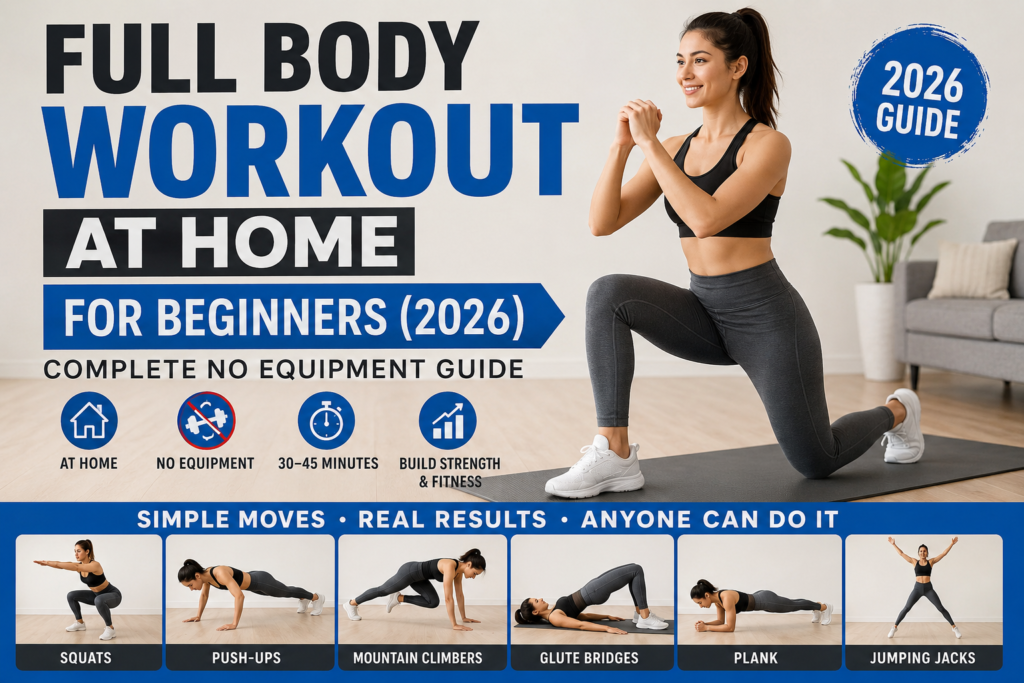

Starting your fitness journey can feel overwhelming, especially when you think you need expensive gym memberships or fancy equipment. The truth is, a full body workout at home for beginners is one of the most effective ways to build strength, burn fat, and improve your health — all without spending a single rupee on a gym.
Whether you are a complete beginner or someone getting back into fitness after a long break, this guide will walk you through everything you need to know. By the end, you will have a clear workout plan, understand proper form, and feel confident enough to start today.
Why a Full Body Workout at Home for Beginners Is the Best Starting Point
When people first start working out, they often make the mistake of jumping into complicated split routines. A full body approach is smarter for beginners for several important reasons.
First, training your entire body in one session means each muscle group gets stimulated multiple times per week. This leads to faster strength gains and better muscle development compared to training one muscle group per day.
Second, full body workouts are extremely time-efficient. Instead of spending an hour just on chest or just on legs, you hit everything in one focused session. For busy people, this is a game changer.
Third, performing movements that involve multiple muscle groups at once teaches your body to work as a unit. This improves coordination, balance, and functional strength that actually helps you in real life — whether you are carrying groceries or climbing stairs.
Finally, doing a full body workout at home for beginners removes every possible excuse. No commute to the gym. No waiting for equipment. No intimidating environment. Just you, your body, and your goals.
Which Dry Fruit is Best For Weight Loss? (Complete 2026 Guide for India)
What You Need Before You Start
The beauty of bodyweight training is that you need almost nothing to begin. Here is a simple checklist:
A clear space of about 6 feet by 6 feet is enough for most exercises. A yoga mat or a soft rug will protect your knees and wrists. Comfortable, breathable clothing allows you to move freely. A water bottle keeps you hydrated throughout the session. A phone or timer helps you track rest periods and sets.
That is honestly everything. No dumbbells, no resistance bands, no pull-up bar required for the beginner phase. Your own bodyweight provides more than enough resistance when you are just starting out.
Understanding the Basics: Sets, Reps, and Rest
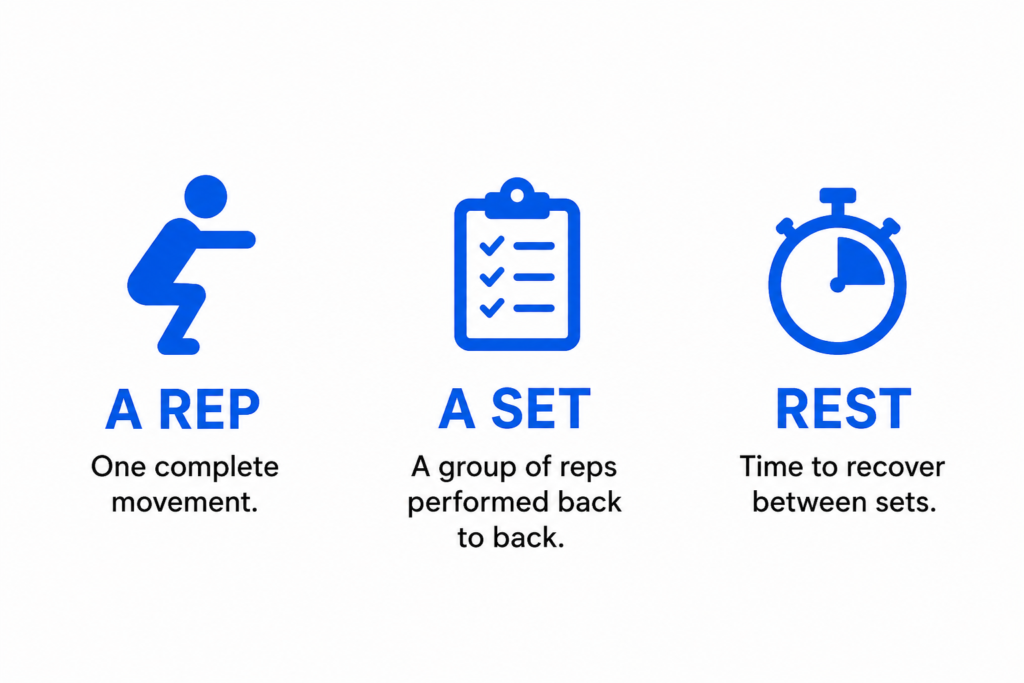
Before jumping into the exercises, let us quickly cover three terms you will see throughout this guide.
A rep (repetition) is one complete movement of an exercise. For example, going down into a squat and coming back up is one rep.
A set is a group of reps performed back to back without stopping. So “3 sets of 10 squats” means you do 10 squats, rest, then do 10 more, rest, then do 10 more.
Rest is the time you take between sets to recover. For beginners, 60 to 90 seconds of rest between sets is ideal. It gives your muscles enough time to recover without letting your heart rate drop completely.
As a beginner, always prioritize form over speed or heavy loads. A slow, controlled rep with perfect technique will always produce better results than rushing through sloppy movement.
Best Morning Routine for Muscle Gain (2026) – Build Muscle Faster Every Day
The Complete Full Body Workout at Home for Beginners
This workout is designed to be done 3 days per week with at least one rest day between sessions. A good schedule would be Monday, Wednesday, and Friday.
Each session should take about 30 to 45 minutes including warm-up and cool-down.
Warm-Up (5 to 7 Minutes)
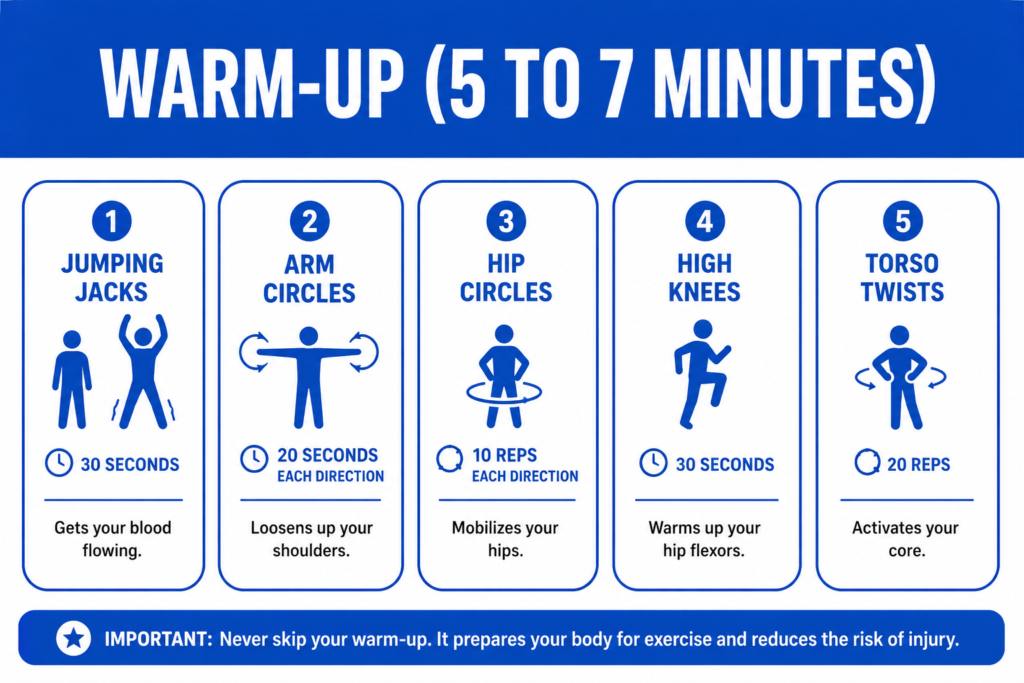
Never skip your warm-up. It prepares your joints and muscles for work, raises your body temperature, and dramatically reduces the risk of injury.
Jumping Jacks — 30 seconds: A classic full-body movement that gets your blood flowing immediately.
Arm Circles — 20 seconds each direction: Loosens up your shoulder joints before any upper body work.
Hip Circles — 10 reps each direction: Mobilizes your hips and lower back, which are heavily used in squats and lunges.
High Knees — 30 seconds: Elevates your heart rate and warms up the hip flexors.
Torso Twists — 20 reps: Activates the core and loosens the spine.
After this warm-up, your body is ready to train.
Walking for Weight Loss at Home (2026) – Simple Daily Plan for Beginners
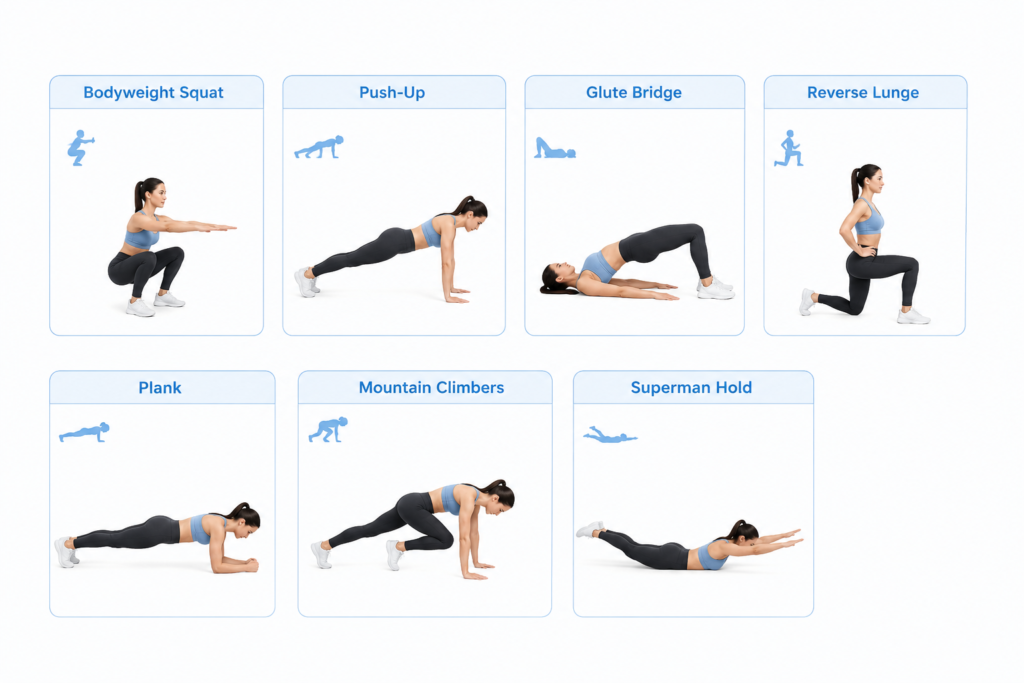
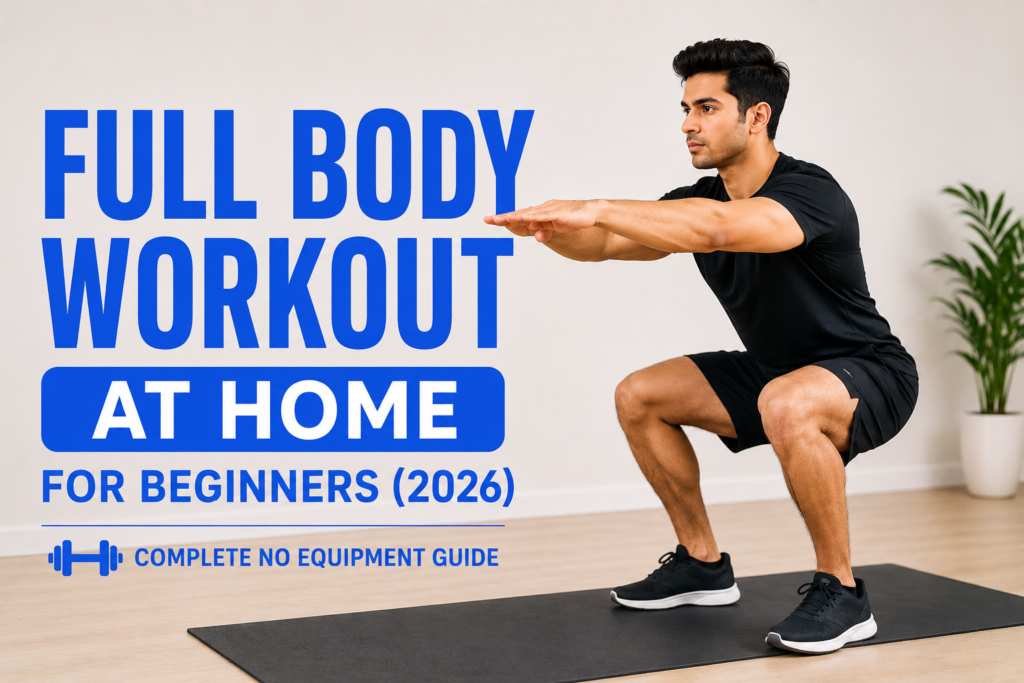
Exercise 1: Bodyweight Squat
The squat is the king of lower body exercises and a cornerstone of any full body workout at home for beginners. It targets your quadriceps, hamstrings, glutes, and core all at once.
How to do it: Stand with your feet shoulder-width apart and toes pointing slightly outward. Push your hips back and bend your knees as if you are sitting down into a chair. Lower yourself until your thighs are parallel to the floor, or as low as comfortable. Keep your chest up and your back straight throughout the movement. Drive through your heels to return to the starting position.
Sets and Reps: 3 sets of 12 to 15 reps
Common mistake to avoid: Do not let your knees cave inward as you lower down. Push them out in line with your toes at all times.
Exercise 2: Push-Up
The push-up is one of the best upper body exercises ever created. It works your chest, shoulders, triceps, and core simultaneously. It is a non-negotiable part of any beginner full body workout at home.
How to do it: Start in a high plank position with your hands slightly wider than shoulder-width apart. Your body should form a straight line from head to heels. Lower your chest toward the floor by bending your elbows at a 45-degree angle from your body. Stop just before your chest touches the ground, then push back up to the starting position.
Modification for beginners: If a full push-up is too difficult, drop to your knees. Keep your core tight and maintain a straight line from knees to shoulders.
Sets and Reps: 3 sets of 8 to 12 reps
Exercise 3: Glute Bridge
The glute bridge targets your glutes, hamstrings, and lower back. It also helps activate muscles that are often weak due to prolonged sitting, making it especially valuable for beginners.
How to do it: Lie on your back with knees bent and feet flat on the floor, hip-width apart. Press your feet into the floor and squeeze your glutes as you lift your hips toward the ceiling. Your body should form a straight line from your shoulders to your knees at the top. Hold for one second, then slowly lower your hips back down.
Sets and Reps: 3 sets of 15 reps
Best Foods for Muscle Gain and Faster Recovery in 2026: Complete Nutrition Guide
Exercise 4: Reverse Lunge
Lunges develop single-leg strength, balance, and coordination. The reverse lunge is easier on the knees than a forward lunge, making it perfect for a full body workout at home for beginners.
How to do it: Stand tall with your feet together. Step one foot backward and lower your back knee toward the floor. Your front thigh should be roughly parallel to the ground. Push through your front heel to return to standing. Alternate legs with each rep.
Sets and Reps: 3 sets of 10 reps per leg
Exercise 5: Plank
The plank is the gold standard of core training. A strong core protects your spine, improves your posture, and makes every other exercise more effective.
How to do it: Start face down and prop yourself up on your forearms and toes. Your elbows should be directly under your shoulders. Keep your body in a perfectly straight line — do not let your hips sag or rise. Breathe steadily and hold the position.
Sets and Duration: 3 sets of 20 to 30 seconds. Build toward 60 seconds over time.
Exercise 6: Mountain Climbers
Mountain climbers combine core stability with cardiovascular effort. They raise your heart rate while working your abs, shoulders, and hip flexors — making them a highly efficient addition to your home workout.
How to do it: Start in a high plank with arms straight and hands under shoulders. Drive one knee toward your chest, then quickly switch legs in a running motion. Keep your hips level and your core braced throughout.
Sets and Duration: 3 sets of 20 seconds
Exercise 7: Superman Hold
This exercise targets the often-neglected muscles of the lower back, glutes, and rear shoulders. Strengthening these muscles helps correct the poor posture that comes from sitting at a desk all day.
How to do it: Lie face down on the floor with arms extended overhead. Simultaneously lift your arms, chest, and legs off the floor as high as comfortable. Hold for two seconds at the top, then slowly lower back down.
Sets and Reps: 3 sets of 10 to 12 reps
Cool-Down (5 Minutes)
After every workout, spend at least five minutes stretching. This reduces muscle soreness, improves flexibility, and helps your body recover faster.
Hold each stretch for 20 to 30 seconds without bouncing. Focus on your quads, hamstrings, hip flexors, chest, and shoulders — the main muscles worked in this session.
How to Stay Fit at Home Without Equipment: 15 Easy Tips for Beginners
Your 4-Week Beginner Workout Schedule
Here is how to structure your first four weeks of doing a full body workout at home for beginners.
Week 1 and 2: Follow the workout exactly as written. Focus entirely on learning proper form. Do not rush through reps. Rest 90 seconds between sets.
Week 3: Add one more set to each exercise. So instead of 3 sets, you are now doing 4 sets. Reduce rest periods to 60 seconds.
Week 4: Try to increase your reps by 2 to 3 on each exercise. For example, if you were doing 12 squats, aim for 14 or 15. This principle is called progressive overload and it is the key to continued progress.
Nutrition Tips to Support Your Full Body Workout at Home
Exercise is only one half of the equation. What you eat significantly affects your results, your energy levels, and how quickly you recover.
Eat enough protein to support muscle repair and growth. Good sources include eggs, dal, paneer, chicken, fish, and Greek yogurt. Aim for at least 0.8 grams of protein per kilogram of body weight daily.
Stay hydrated. Dehydration reduces your performance and slows recovery. Drink at least 2 to 3 liters of water per day, and more on workout days.
Do not fear carbohydrates. Rice, roti, oats, and fruit give you the energy you need to train hard. Cutting carbs too aggressively will leave you feeling weak and sluggish.
Avoid processed foods and sugary drinks as much as possible. They spike your blood sugar, cause energy crashes, and provide very little nutritional value.
Common Mistakes Beginners Make (And How to Avoid Them)
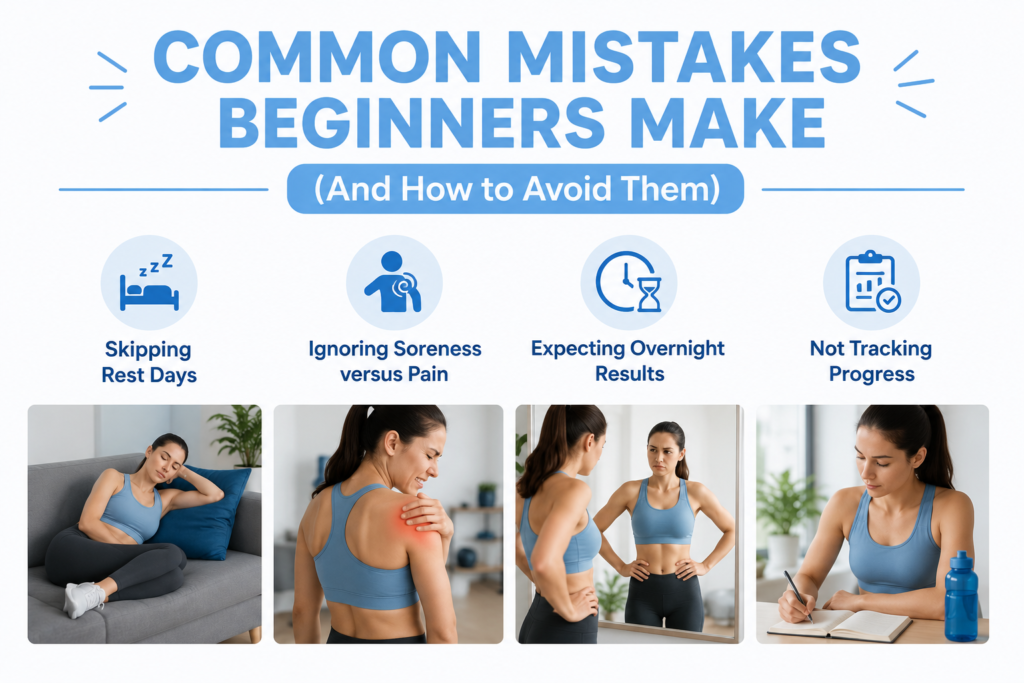
Skipping rest days: Muscles grow during rest, not during the workout itself. More training is not always better. Stick to 3 days per week and let your body recover.
Ignoring soreness versus pain: Muscle soreness 24 to 48 hours after a workout is completely normal. Sharp, sudden pain during an exercise is not. Stop immediately if something hurts.
Expecting overnight results: Fitness takes time. Most beginners start to notice visible changes after 4 to 6 weeks of consistent effort. Trust the process and keep showing up.
Not tracking progress: Write down your sets, reps, and how the workout felt after each session. Tracking keeps you accountable and helps you see how far you have come.
30 Day Home Workout Challenge for Weight Loss – Complete Beginner Plan (2026)
How to Progress Beyond This Beginner Workout
After completing the 4-week plan, you will be ready to advance. Here are some ways to keep progressing with your full body workout at home for beginners turned intermediate routine.
Add resistance by using a backpack filled with books or water bottles as a makeshift weight. Introduce more challenging exercise variations such as jump squats, decline push-ups, or single-leg glute bridges. Increase workout frequency to 4 days per week. Explore bodyweight skills like pike push-ups or assisted pistol squats.
The key principle remains the same: always make your workouts slightly harder over time. That consistent challenge is what drives long-term results.
Final Thoughts
A full body workout at home for beginners is not a compromise — it is a smart, effective, and proven strategy to build real fitness. You do not need a gym, expensive equipment, or hours of free time. You need consistency, proper form, and the right plan.
The workout in this guide gives you everything you need to start building a stronger, healthier body today. Follow the schedule, eat well, sleep enough, and trust the process. Your results will come.
Now close this tab, clear a space on your floor, and get started. Your fitness journey begins right now.