

If you are serious about building muscle, your morning routine matters more than you think. Most people focus only on their gym sessions and nutrition, but the first 60–90 minutes of your day can either set you up for maximum muscle growth or silently sabotage your results. In 2026, fitness science has made it clear: the Best Morning Routine for Muscle Gain is not just about lifting heavy — it is about what you do before you even touch a barbell.
This complete guide walks you through a science-backed, step-by-step morning routine designed specifically for muscle gain. Whether you are a beginner or an experienced lifter, following this routine consistently will help you build muscle faster, recover better, and perform at your peak every single day.
Why Your Morning Routine Directly Affects Muscle Growth

Many people underestimate the role of morning habits in muscle development. Your body goes through a 7–9 hour fasting period during sleep, which means your muscles are in a slightly catabolic state when you wake up. Cortisol levels are naturally elevated in the morning, which can break down muscle tissue if you do not counter it with the right habits.
The Best Morning Routine for Muscle Gain works by hydrating your body, fueling your muscles with the right nutrients, priming your nervous system for training, and reducing cortisol spikes — all before your workout even begins. When done consistently, these morning habits create the perfect hormonal and physiological environment for muscle growth.
Research published in sports nutrition journals consistently shows that athletes who follow a structured pre-training morning routine gain lean muscle faster than those who train without preparation. Your morning is not wasted time — it is your secret weapon.
Walking for Weight Loss at Home (2026) – Simple Daily Plan for Beginners
Step 1: Wake Up and Hydrate Immediately (0–5 Minutes)
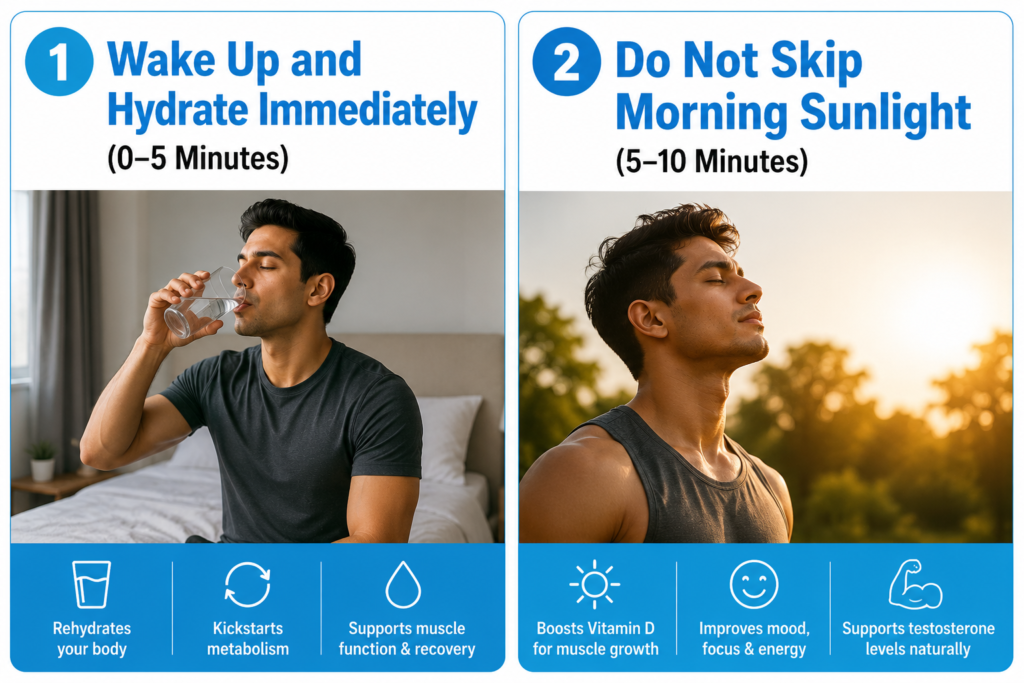
The very first thing you should do after waking up is drink water. During 7–8 hours of sleep, your body loses a significant amount of fluid through breathing and perspiration. Even mild dehydration of 1–2% can reduce muscle strength, endurance, and protein synthesis.
As soon as you open your eyes, drink 400–600 ml (roughly two glasses) of water. Many serious athletes add a pinch of Himalayan salt or an electrolyte tablet to replenish sodium levels, which supports muscle contractions and nerve signals throughout the day.
This single habit, done every morning, dramatically improves workout performance and nutrient delivery to your muscles. It is the simplest yet most overlooked part of the Best Morning Routine for Muscle Gain.
Step 2: Do Not Skip Morning Sunlight (5–10 Minutes)
Within 30 minutes of waking up, spend 5–10 minutes in natural sunlight. This is not just a wellness trend — it is backed by solid science. Morning sunlight exposure regulates your circadian rhythm, boosts serotonin, and increases natural testosterone production. Testosterone is the primary anabolic hormone responsible for muscle protein synthesis.
Step outside, open your curtains, or sit near a window. Even on cloudy days, natural light is far more powerful than indoor lighting for triggering these hormonal benefits.
This step is often missing from generic fitness advice, but it is an essential part of the Best Morning Routine for Muscle Gain because it primes your hormonal environment before you ever pick up a weight.
How to Stay Fit at Home Without Equipment: 15 Easy Tips for Beginners
Step 3: Perform a 5-Minute Mobility and Activation Warm-Up (10–20 Minutes)
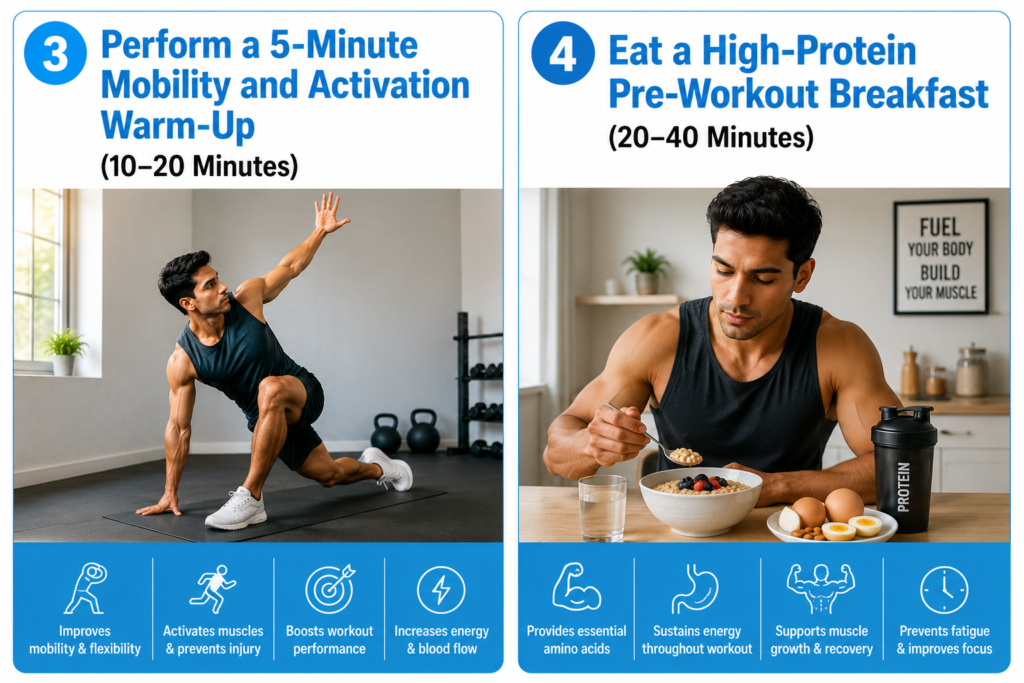
Cold muscles are injury-prone muscles. Before any strength training session, your joints and connective tissue need to be warmed up and your stabilizer muscles need to be activated. Skipping this step is one of the biggest mistakes lifters make.
Spend 5–10 minutes on targeted mobility work and muscle activation exercises. Focus on the muscle groups you plan to train that day. For example, if it is leg day, perform hip circles, glute bridges, bodyweight squats, and ankle rotations. If it is upper body day, do arm circles, band pull-aparts, thoracic rotations, and shoulder dislocations.
This warm-up does three critical things for muscle gain. It increases blood flow and oxygen delivery to muscles. It activates the neuromuscular connection so your muscles fire more efficiently during heavy lifts. It reduces injury risk, ensuring you can train consistently without setbacks.
Consistency in training is what builds muscle. Missing workouts due to injuries destroys your progress. A proper warm-up is non-negotiable in the Best Morning Routine for Muscle Gain.
Step 4: Eat a High-Protein Pre-Workout Breakfast (20–40 Minutes)
Nutrition timing is one of the most researched areas in sports science, and the verdict is clear: eating a protein-rich meal 45–90 minutes before training significantly enhances muscle protein synthesis and workout performance.
Your pre-workout breakfast should contain high-quality protein, moderate carbohydrates for energy, and minimal fat (fat slows digestion, which is not ideal before a training session).
Ideal Pre-Workout Breakfast Options for Muscle Gain:
A combination of eggs and oats is a classic choice — 3–4 whole eggs provide complete protein with all essential amino acids, while oats deliver slow-releasing carbohydrates that sustain energy during your workout. Greek yogurt with fruit and granola is another excellent option, offering both casein and whey proteins alongside fast-digesting carbohydrates. A protein shake with a banana works perfectly if you prefer a lighter option before training.
Aim for 30–40 grams of protein and 50–70 grams of carbohydrates in this meal. This macronutrient combination fuels your muscles during the workout and jump-starts the muscle protein synthesis process, making it a cornerstone of the Best Morning Routine for Muscle Gain.
30 Day Home Workout Challenge for Weight Loss – Complete Beginner Plan (2026)
Step 5: Take Your Supplements Strategically (30–45 Minutes Before Training)
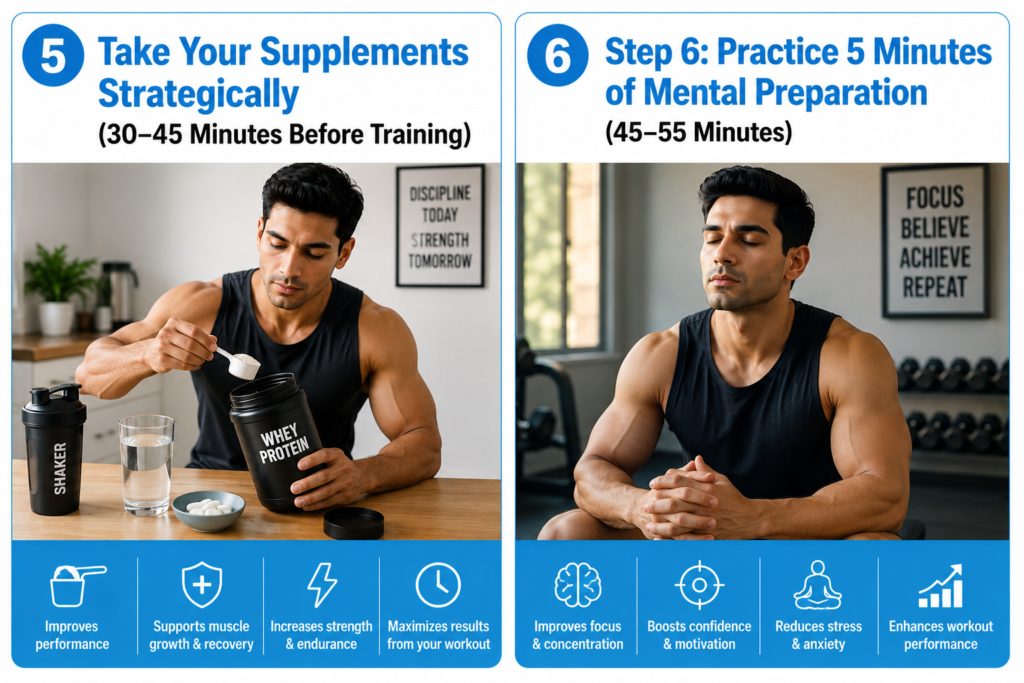
Not all supplements are created equal, and timing matters. Taking the right supplements at the right time in the morning can meaningfully improve training performance and muscle gain.
Creatine Monohydrate is the most well-researched supplement in history for muscle gain. Taking 3–5 grams daily, regardless of timing, saturates your muscle cells with phosphocreatine, which directly fuels high-intensity strength training. Many athletes take it with their morning meal for consistency.
Caffeine taken 30–45 minutes before training improves strength output, endurance, and focus. 150–200 mg from coffee or a pre-workout supplement is sufficient for most people. Avoid excessive caffeine, as it can spike cortisol and interfere with recovery.
Branched-Chain Amino Acids (BCAAs) or a complete Essential Amino Acid (EAA) supplement taken before training can reduce muscle breakdown and support protein synthesis during your workout, especially if you train in a fasted or semi-fasted state.
Being strategic with your supplement timing is a powerful but often neglected component of the Best Morning Routine for Muscle Gain.
Step 6: Practice 5 Minutes of Mental Preparation (45–55 Minutes)
The mind-muscle connection is real and measurable. Studies using EMG (electromyography) have shown that athletes who mentally visualize their workout before training activate more muscle fibers during the actual session. Greater muscle fiber activation means greater mechanical tension, which is the primary driver of muscle hypertrophy.
Before your workout, spend 5 minutes in a focused mental state. You can do this while stretching or simply sitting quietly. Visualize each exercise you plan to do. Imagine the full range of motion, feel the muscles contracting and stretching, and mentally rehearse hitting your target reps and weights.
This practice also reduces pre-workout anxiety and builds confidence under heavier loads — both of which directly impact training performance and long-term muscle development.
Elite athletes across every sport use mental preparation as a daily practice. Adding it to your Best Morning Routine for Muscle Gain takes only 5 minutes but can produce measurable improvements in your training results within weeks.
Best Foods for Muscle Gain and Faster Recovery in 2026: Complete Nutrition Guide
Step 7: Train with Purpose and Progressive Overload (55–90 Minutes)

This is the core of your morning routine. Everything done before this moment was preparation for this — and when your preparation is right, your training quality improves dramatically.
The most important principle for muscle gain during your workout is progressive overload: consistently increasing the challenge placed on your muscles over time. This can be done by adding weight, adding reps, reducing rest time, or improving form and range of motion.
Follow a structured training program that prioritizes compound movements such as squats, deadlifts, bench press, overhead press, bent-over rows, and pull-ups. These multi-joint exercises recruit the most muscle mass and produce the greatest hormonal response for muscle growth.
Train each muscle group with sufficient volume — typically 10–20 sets per week per muscle group — spread across 3–5 training sessions. Rest 60–90 seconds between hypertrophy sets and 2–3 minutes between heavy strength sets to optimize performance and hormone response.
The combination of a well-prepared body and a structured program built on progressive overload is the engine of the Best Morning Routine for Muscle Gain.
Step 8: Post-Workout Nutrition – Do Not Miss This Window (Within 30–60 Minutes After Training)
The anabolic window after training is real. Your muscles are primed to absorb nutrients immediately after a workout, when muscle protein synthesis rates are elevated and glycogen stores are depleted. Failing to eat after training leaves muscle gains on the table.
Within 30–60 minutes of finishing your workout, consume a meal or shake containing 30–50 grams of high-quality protein and 50–80 grams of fast-digesting carbohydrates. A whey protein shake with a banana, or a meal of chicken rice and vegetables, both work excellently.
This post-workout nutrition step is technically the end of your morning training routine, but it is inseparable from everything that came before it. Treat it as the final step — not an optional extra — in your Best Morning Routine for Muscle Gain.
Lazy Girl Weight Loss Routine at Home for Beginners (2026)
The Complete Morning Routine at a Glance
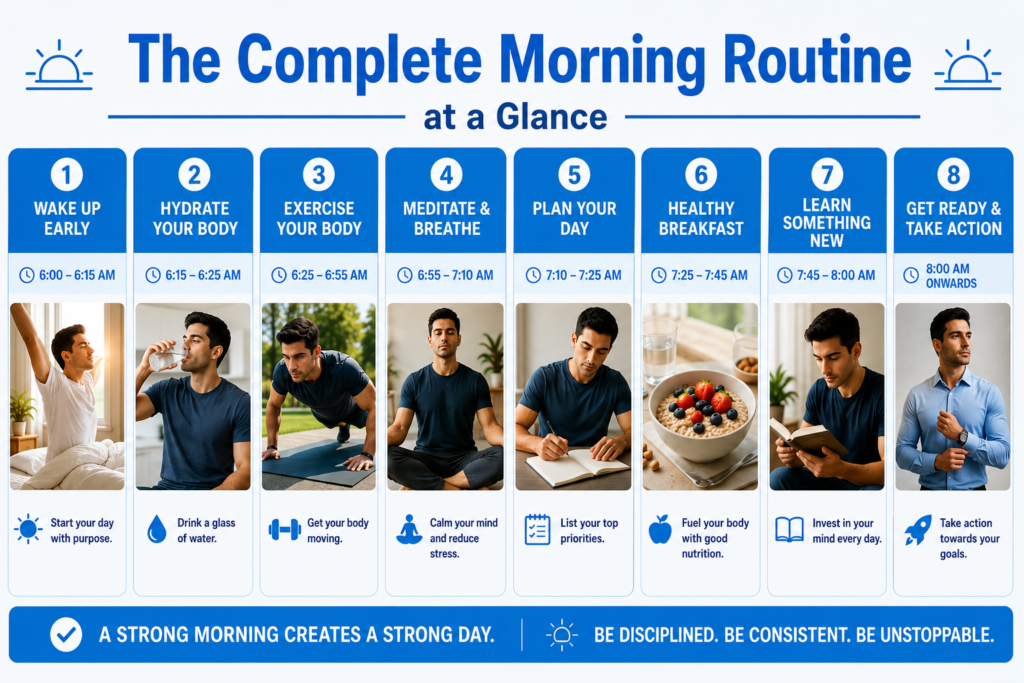
Here is your full Best Morning Routine for Muscle Gain summarized in a simple time structure you can follow every training day:
Wake Up (0 min) – Drink 400–600 ml of water immediately upon waking.
Minutes 5–10 – Get 5–10 minutes of natural morning sunlight exposure.
Minutes 10–20 – Complete a targeted mobility warm-up and muscle activation routine.
Minutes 20–40 – Eat a high-protein, moderate-carbohydrate pre-workout breakfast.
Minutes 30–45 – Take your pre-workout supplements (creatine, caffeine, EAAs as needed).
Minutes 45–55 – Spend 5 minutes on mental preparation and workout visualization.
Minutes 55–90+ – Train with intensity, focus, and progressive overload.
Within 60 Minutes Post-Workout – Consume your post-workout protein and carbohydrate meal.
Common Morning Routine Mistakes That Kill Muscle Gains
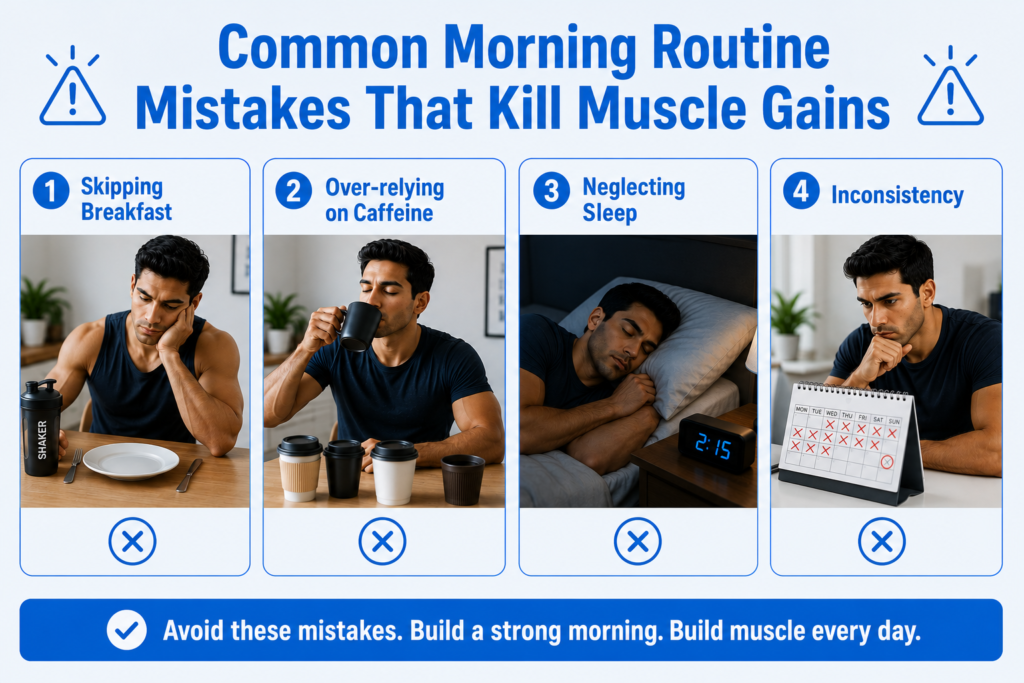
Even with the best intentions, many people make errors in their morning routine that quietly undermine their muscle building progress. Understanding these mistakes helps you avoid them.
Skipping Breakfast Before Training is one of the most common errors. While intermittent fasting has its place, training heavy in a completely fasted state without any protein or carbohydrate intake leads to increased muscle catabolism and reduced performance. If you prefer training fasted, at minimum consume BCAAs or EAAs before training to protect your muscle tissue.
Over-relying on Caffeine is another widespread problem. Taking 400+ mg of caffeine before training spikes cortisol dramatically, which counteracts the anabolic environment you are trying to create. Keep caffeine moderate and combine it with food to blunt the cortisol response.
Neglecting Sleep as Part of the Morning Routine is perhaps the biggest mistake of all. Your morning routine actually begins the night before. If you are sleeping only 5–6 hours, no amount of morning optimization will fully compensate. Aim for 7–9 hours of quality sleep, as this is when 90% of muscle repair and growth actually occurs through the release of growth hormone.
Inconsistency destroys results faster than any single mistake. The Best Morning Routine for Muscle Gain only works when it is practiced daily, not occasionally. Build these habits gradually over 2–4 weeks until they become automatic.
Best Fitness Tips Without Gym for a Healthy Lifestyle in 2026
How Long Until You See Results?
Following a consistent, structured Best Morning Routine for Muscle Gain produces visible and measurable results within a predictable timeline for most people.
In the first two weeks, you will notice improved workout performance, better energy levels throughout the day, and faster recovery between sessions. In weeks 3–6, you will begin to see changes in muscle hardness, definition, and strength numbers. By weeks 8–12, with consistent training and nutrition, visible muscle mass gains become clear and measurable through body composition changes.
Results vary based on training experience, genetics, overall calorie and protein intake, and sleep quality. However, the structure and habits described in this guide accelerate the process significantly compared to training without a morning routine.
Final Thoughts
Building muscle is not just about the hours you spend in the gym. It is about creating the right conditions for growth throughout your entire day — and that starts the moment you wake up. The Best Morning Routine for Muscle Gain combines hydration, sunlight, nutrition, mobility, mental preparation, and strategic training into a repeatable daily system that turns your body into a muscle-building machine.
Start implementing these steps one at a time if the full routine feels overwhelming. Begin with hydration and breakfast, then add the warm-up, then the supplement timing, and gradually build the complete routine over 2–4 weeks. Consistency over time is what separates people who build impressive physiques from those who train for years without seeing meaningful change.