
Most people believe that building muscle requires hours in the gym every day. The truth is entirely different. If you genuinely want to know how to build muscle with a busy schedule, you are in the right place. With the right approach, you can make remarkable progress in just 30 minutes a day — even with the most demanding lifestyle. This guide is designed specifically for beginners who want to build muscle with a busy schedule without sacrificing work, family, or sleep.
Why Busy People Struggle to Build Muscle (And Why It Does Not Have to Be That Way)

The number one reason people fail to build muscle is not lack of effort — it is lack of a realistic system. Most workout programs are built for people who have two hours free every afternoon. When you are juggling a full-time job, family responsibilities, and personal commitments, following a traditional gym program feels impossible.
But here is what science tells us: muscle growth is primarily triggered by progressive overload, not by the total time you spend working out. As long as you are consistently challenging your muscles with increasing resistance, your body will respond by building new muscle tissue. A focused 30-minute session can deliver the same stimulus as a 90-minute casual gym visit — sometimes more, because there is no time wasted.
The key is efficiency. Every minute of your 30-minute routine needs to count.
Which Dry Fruit is Best For Weight Loss? (Complete 2026 Guide for India)
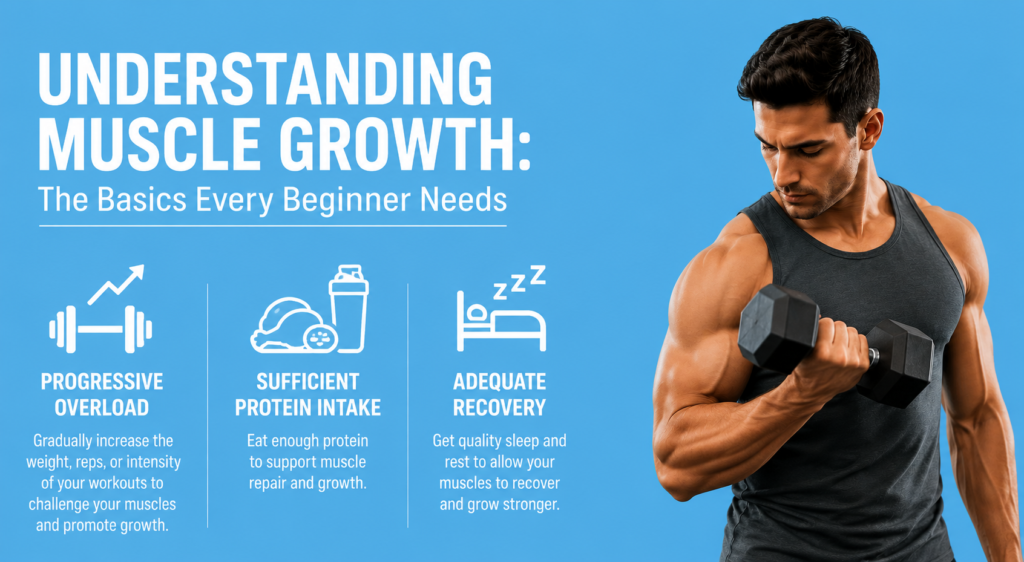
Understanding Muscle Growth: The Basics Every Beginner Needs
Before jumping into the routine, it helps to understand what actually triggers muscle growth. When you lift weights or perform resistance exercises, you create microscopic tears in your muscle fibers. During rest and recovery, your body repairs those fibers and makes them slightly thicker and stronger than before. This process is called muscle hypertrophy.
For this process to work effectively, three conditions must be met consistently:
Progressive Overload: You must gradually increase the challenge on your muscles over time — through more weight, more reps, or less rest between sets. Without this, your muscles have no reason to grow.
Sufficient Protein Intake: Your body needs protein as the building block for new muscle tissue. Without enough dietary protein, even the best workout program will produce minimal results.
Adequate Recovery: Muscle is not built during the workout — it is built during rest. Sleep and recovery days are not optional; they are when the actual growth happens.
If all three conditions are consistently met, even a 30-minute workout done four days a week will produce visible, measurable results for beginners within 6 to 8 weeks. This is exactly why how to build muscle with a busy schedule is not just possible — it is highly achievable with the right plan.
Best Breakfast for Weight Loss and Fat Loss: 15 Healthy Indian Options (2026)
The 30-Minute Muscle-Building Routine for Beginners

This routine is designed around compound exercises — movements that work multiple muscle groups at the same time. Compound exercises give you the most muscle-building return for every minute invested, making them perfect when you are learning how to build muscle with a busy schedule.
The structure follows a Push/Pull/Legs split across four days per week, with three rest days for recovery. Each session lasts exactly 30 minutes when you follow the timing guidelines below.
Day 1 — Push Day (Chest, Shoulders, Triceps)
This session targets the muscles involved in pushing movements. Begin with a 3-minute dynamic warm-up: arm circles, shoulder rolls, and light bodyweight squats to get blood moving.
Workout (27 minutes):
Perform each exercise for 3 sets of 10 to 12 reps. Rest 60 seconds between sets. Move to the next exercise with minimal delay.
- Push-Ups (or Dumbbell Bench Press): The foundation of chest development. Keep your core tight and lower chest to just above the floor for full range of motion.
- Dumbbell Shoulder Press: Seated or standing, press dumbbells from shoulder height directly overhead. This builds width and shoulder strength simultaneously.
- Dumbbell Lateral Raises: Light weight, controlled movement. Raise arms to shoulder level and lower slowly. Do not swing the weight.
- Tricep Dips (or Tricep Pushdowns): Use a chair or bench for dips. Lower slowly, press up powerfully.
Rest 90 seconds between exercises to keep total time under 30 minutes.
Day 2 — Pull Day (Back, Biceps)
Pull exercises are often neglected by beginners but are essential for a balanced, strong physique and good posture.
Workout (27 minutes):
- Dumbbell Rows (Single Arm): Place one knee on a bench, row a dumbbell from a hanging position to your hip. This targets the lat muscle — the widest muscle in your back.
- Resistance Band Pull-Aparts: Hold a band in front of you at chest height and pull it apart to a T-shape. Excellent for rear deltoids and upper back.
- Dumbbell Bicep Curls: Classic movement. Focus on the squeeze at the top of each rep and the slow lowering phase.
- Inverted Rows (or Band-Assisted Pull-Ups): If you have a low bar or smith machine, inverted rows build back strength rapidly for beginners.
Day 3 — Rest or Active Recovery
Do not skip rest days in pursuit of faster progress. This is when your muscles are actually growing. Light walking, stretching, or 20 minutes of yoga is perfectly fine and can support recovery without setting it back.
Day 4 — Leg Day (Quads, Hamstrings, Glutes, Calves)
The legs contain some of the largest muscles in the body. Training them releases significant amounts of growth hormone, which benefits your entire body — not just your legs.
Workout (27 minutes):
- Goblet Squats: Hold a single dumbbell at chest height and squat to parallel or below. This is the safest and most effective squat variation for beginners.
- Romanian Deadlifts (RDLs): Hold dumbbells in front of your thighs and hinge at the hips, lowering the weights along your legs until you feel a hamstring stretch. Return to standing by driving your hips forward.
- Walking Lunges: Step forward into a lunge, lower back knee toward the floor, and push up to bring feet together before the next step.
- Calf Raises: Simple but effective. Stand on a step or flat floor and raise onto your toes slowly, then lower with control.
Day 5 — Full Body Circuit
This session ties everything together with a circuit format that builds muscle and improves cardiovascular conditioning simultaneously. Perform all four exercises back-to-back with no rest between them, then rest 90 seconds and repeat for 4 rounds total.
Circuit (3-4 rounds):
- 10 Push-Ups
- 10 Goblet Squats
- 10 Dumbbell Rows (each side)
- 15 seconds Plank Hold
This session keeps your heart rate elevated, burns additional calories, and reinforces the major movement patterns from earlier in the week.
Days 6 and 7 — Rest
Two full rest days at the end of the week allow for complete recovery before the next cycle begins. Sleep 7 to 9 hours during these days if possible. This is not laziness — this is training.
15 Fitness and Diet Tips for Fast Weight Loss at Home (Beginner’s Guide)”
Nutrition: How to Eat for Muscle Growth When You Are Always Busy

One of the most overlooked aspects of how to build muscle with a busy schedule is nutrition. The best workout program in the world will not build muscle without proper nutrition. For busy people, the goal is to make healthy eating as simple and automatic as possible — not to prepare elaborate meals three times a day.
Protein First, Always
Aim for 0.7 to 1 gram of protein per pound of body weight each day. For a 160-pound person, that is roughly 110 to 160 grams of protein daily. The best high-protein foods that require minimal preparation include eggs, Greek yogurt, cottage cheese, canned tuna, rotisserie chicken, and protein shakes.
A simple approach that works well for busy people is to prepare protein sources in bulk on Sundays. Cook a large batch of chicken breasts, hard-boil a dozen eggs, and pre-portion Greek yogurt into containers. This way, protein is always available without requiring any decision-making during the week.
Carbohydrates Are Not the Enemy
Your muscles run on glycogen, which comes from carbohydrates. Complex carbs like oats, brown rice, sweet potatoes, and whole grain bread give you sustained energy throughout the day and fuel your workouts. Do not cut carbs aggressively when trying to build muscle — especially as a beginner.
Eat Around Your Workouts
If you train in the morning before work, eat a small carbohydrate-rich snack beforehand (like a banana and a handful of nuts) and have a protein-rich meal or shake within 60 minutes after training. If you train in the evening, make sure your dinner contains a solid protein source alongside complex carbs. This timing is not critical to the minute, but consistent nutrient intake around training improves recovery meaningfully over time.
Home Workout for Overweight Female Beginners 2026 – Easy Weight Loss Plan at Home
Sleep and Recovery: The Most Underrated Factor in Muscle Building

If you are trying to learn how to build muscle with a busy schedule, you are probably also sleeping less than you should. This is the single biggest mistake busy people make. Growth hormone — the primary hormonal driver of muscle development — is secreted almost entirely during deep sleep. Without adequate sleep, even perfect training and perfect nutrition will produce only a fraction of the possible results.
Prioritizing 7 to 9 hours of sleep per night is genuinely more important than any supplement, any training technique, or any dietary tweak. If you cannot consistently sleep 7 hours, address that before adding workout volume or intensity.
How to Stay Consistent When Life Gets in the Way

Consistency over perfection is the only philosophy that works long-term. When figuring out how to build muscle with a busy schedule, the people who succeed are not the ones with the most time — they are the ones who show up most consistently. A workout done imperfectly is infinitely more effective than a perfect workout that never happens.
Here are practical strategies to stay on track:
Schedule workouts like meetings. Put them in your calendar with a reminder. Treat them as non-negotiable appointments with yourself.
Keep your equipment accessible. A set of dumbbells and a resistance band stored visibly in your bedroom or home office removes every friction point. You are far more likely to train if setup takes 10 seconds, not 10 minutes.
Have a fallback 15-minute workout. On days when even 30 minutes feels impossible, a 15-minute workout is dramatically better than nothing. Keep a short routine (push-ups, squats, rows, lunges) written on your phone as a note for these days.
Track your progress. Write down the weights and reps you complete each session. Seeing your numbers increase over weeks is genuinely motivating and also ensures you are applying progressive overload correctly.
Pair your workout with an existing habit. Many people find that working out immediately before or after an already established habit — like morning coffee, the morning commute, or the kids’ bedtime — makes it easier to maintain consistency without relying on willpower alone.
Muscle Gain Diet Plan for Skinny Guys (2026) – Complete Beginner Guide
Common Mistakes Beginners Make When Learning How to Build Muscle with a Busy Schedule
Skipping compound movements in favor of isolation exercises. Bicep curls are satisfying, but squats and rows will build more total muscle in the same amount of time. Compound movements are the foundation of efficient muscle-building.
Changing the program every two weeks. Consistency with a single program for at least 8 to 12 weeks is necessary to see meaningful results. Constantly switching routines prevents progressive overload from accumulating.
Underestimating the warm-up. A brief 3-minute warm-up reduces injury risk significantly. Injured muscles cannot be trained, and an injury sets you back weeks or months.
Ignoring the importance of water intake. Muscle tissue is approximately 75% water. Dehydration reduces strength, slows recovery, and increases injury risk. Drink at least 2.5 to 3 liters of water per day, more on training days.
Healthy Foods for Weight Loss (2026) – Top 25 Foods That Help Burn Fat Naturally
Sample Weekly Schedule at a Glance
| Day | Session | Duration |
|---|---|---|
| Monday | Push Day | 30 minutes |
| Tuesday | Pull Day | 30 minutes |
| Wednesday | Rest / Active Recovery | — |
| Thursday | Leg Day | 30 minutes |
| Friday | Full Body Circuit | 30 minutes |
| Saturday | Rest | — |
| Sunday | Rest | — |
Final Thoughts: How to Build Muscle with a Busy Schedule — The Long Game
The answer to how to build muscle with a busy schedule is simpler than most people think, but it requires patience. This is a process measured in months, not days. Results from the first two weeks are mostly neurological — your brain is learning to recruit muscle fibers more efficiently. Visible changes in muscle size typically begin around weeks 6 to 8 for most beginners, and become very noticeable by the 3-month mark when training and nutrition are consistent.
You do not need hours in the gym. You do not need an elaborate program. You need a focused 30-minute routine, adequate protein, enough sleep, and the discipline to show up consistently — even on the days when motivation is low. That combination, sustained over time, will produce results that surprise you.
Start simple. Stay consistent. Trust the process.