


Best Daily Fitness Tips for Beginners at Home
If you want to start your fitness journey but do not know where to begin, this guide is made just for you. May be you do not have time to go to the gym. May be the gym is too far from your home. May be you simply cannot afford a gym membership right now. Whatever the reason, you do not need a gym to get fit. “Best Daily Fitness Tips for Beginners at Home (2026 Guide)”You do not need expensive equipment. You do not need a personal trainer. All you need is a little space in your home, a little time every day, and the right guidance.
This guide will give you everything you need to start working out at home as a complete beginner. We will cover warm up, exercises, weekly plans, diet, common mistakes, and how to stay consistent. Read it fully, save it, and come back to it whenever you need a reminder. Let us begin.
Best Daily Fitness Tips for Beginners at Home

Most people think that getting fit requires a gym. This is one of the biggest fitness myths. The truth is that your own body weight is the most powerful fitness tool you will ever have. Push ups, squats, planks, lunges, and jumping jacks can build real strength, burn real fat, and improve your health in a very serious way.
Here is why home workouts are especially good for beginners.
First, there is zero cost involved. You do not pay any fees. You do not need to travel anywhere. You do not need to buy any equipment when you are just starting out.
Second, you save a lot of time. In most Indian cities, going to the gym means at least 30 to 60 minutes of travel every day. When you work out at home, that time is saved completely.
Third, there is no pressure or embarrassment. Many beginners feel shy at the gym because they do not know the machines or the exercises. At home you can make mistakes, go slow, and learn at your own pace with nobody watching.
Fourth, you can work out any time you want. Early morning, late evening, during lunch break. You are in control of your schedule.
Brown Bread Healthy For Weight Loss? Benefits, Calories & Best Brands
The Right Mindset Before You Start
Before you learn a single exercise, you need to fix your mindset. This is more important than any workout plan. Most beginners fail not because of a bad exercise routine but because of the wrong mental approach.
The number one mistake is setting goals that are too big. Do not say “I want six pack abs in one month.” That will not happen and you will give up quickly. Instead say something like “I will exercise three days this week for twenty minutes each day.” That is a real goal. That is something you can actually do.
Start smaller than what feels right. If twenty minutes sounds hard, start with ten minutes. A small habit that you actually follow every day is far better than a big plan that you quit after one week.
The second thing you need to do is prepare your environment.“Best Daily Fitness Tips for Beginners at Home (2026 Guide)” Decide the night before exactly what exercise you will do tomorrow, at what time, and in which part of your home. Keep your workout clothes ready. Remove every possible excuse before it appears.
The third thing is to attach your workout to something you already do every day. For example, after you drink your morning chai, you exercise. The existing habit of drinking chai will remind you to work out. This is called habit stacking and it works very well.
Finally, track your workouts. Keep a simple notebook or use your phone. After every session write down what you did. This creates a record of progress that motivates you to keep going.
Does Honey Help in Weight Loss? Benefits, Myths & Best Ways to Use It (2026 Guide)
Always Warm Up — Never Skip This Step
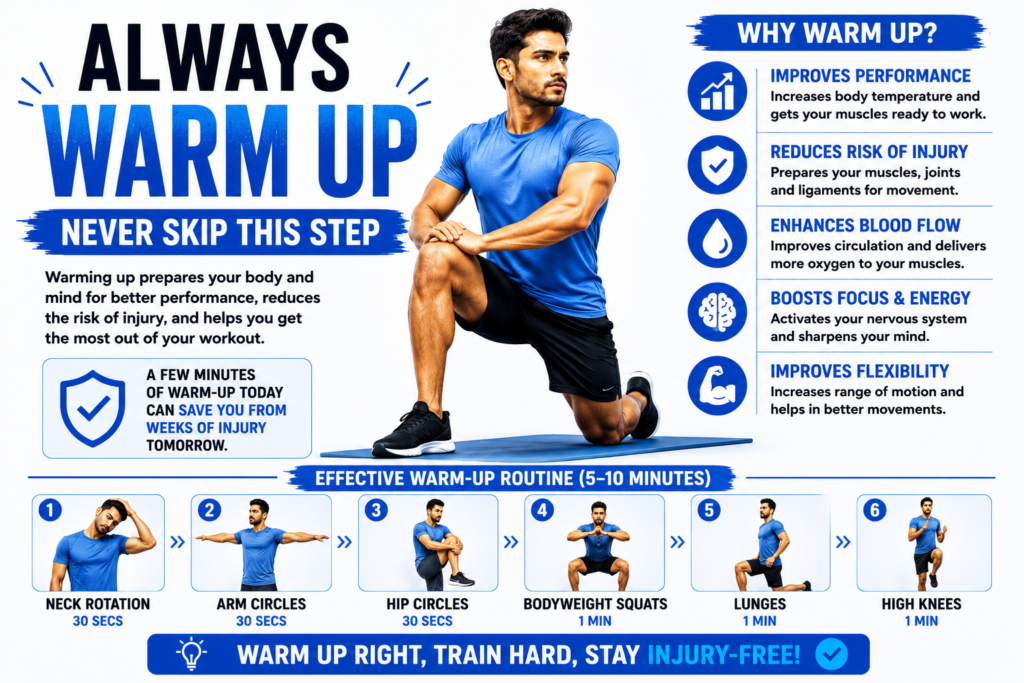
One of the most common mistakes Indian beginners make is jumping straight into exercises without warming up. This is dangerous. A cold body is tight and stiff. Exercising without warming up puts pressure on your joints and muscles and leads to injury.
A proper warm up takes only five minutes but it makes a huge difference. It raises your heart rate gradually, increases blood flow to your muscles, loosens your joints, and prepares your mind for the workout ahead.
Here is a simple five minute warm up you should do before every session.
Start by marching in place for one minute. Lift your knees a little and swing your arms. This gets your blood moving.
Then do shoulder rolls for thirty seconds forward and thirty seconds backward. This loosens up your neck and shoulder area.
Next do hip circles. Place your hands on your hips and rotate them slowly in big circles. Do thirty seconds on each side.
After that swing both arms across your chest and back out for one minute. This opens up your chest and upper back.
Then do ten slow squats with no weight. Just go down gently and come back up. This warms up your legs and knees.
Finally rotate your ankles for thirty seconds each. Many people forget about ankles but they need warming up too especially if you sit all day.
That is your warm up done. Five minutes and your body is ready to exercise safely.
The 5 Best Exercises for Home Beginners
These five exercises cover your entire body. You do not need any equipment. You only need enough space to stand and lie down. Master these five movements and you will have a solid fitness foundation.
Exercise 1 — Squats
Squats are the king of lower body exercises. They work your thighs, hips, glutes, and core all at the same time.
Stand with your feet shoulder width apart. Push your hips back and bend your knees as if you are about to sit on a chair. Lower yourself until your thighs are parallel to the floor or as low as you comfortably can. Keep your chest upright and your weight in your heels. Then push through your heels to stand back up.
Do 3 sets of 12 repetitions. Rest for 45 seconds between sets.
Exercise 2 — Push Ups
Push ups are the best upper body exercise you can do without any equipment. They work your chest, shoulders, and triceps.
If regular push ups on the floor are too hard, start with wall push ups. Stand an arm’s length from the wall, place your palms flat on the wall, and push in and out. Once that becomes easy, move to incline push ups using a chair. Eventually you will build up to full floor push ups.
The key to a good push up is form. Keep your body in a straight line from head to heels. Do not let your hips sag or rise up. Elbows should be at roughly 45 degrees from your body, not flared out wide.
Do 3 sets of 10 repetitions.
Exercise 3 — Plank
The plank is the single best exercise for your core. It strengthens your stomach, lower back, and hips all at once. It also improves your posture which is very important if you sit at a desk all day.
Place your forearms on the floor with elbows directly under your shoulders. Rise up on your toes. Your body should form a straight line from your head to your heels. Hold this position.
Start by holding for 20 seconds. Each week try to add 5 more seconds. Work your way up to 60 seconds over time.
Do 3 sets.
Exercise 4 — Lunges
Lunges work your legs and improve your balance at the same time. They are excellent for building strength in each leg individually.
Stand tall. Step one foot forward and lower your back knee toward the floor. Your front knee should stay directly above your ankle and not go past your toes. Push back up to standing and switch legs.
Do 10 repetitions on each side for 3 sets.
Exercise 5 — Jumping Jacks
Jumping jacks are perfect for getting your heart rate up at home. If you live in an apartment and cannot run, jumping jacks give you a cardio workout without needing much space.
If noise is a concern, do the low impact version. Instead of jumping, step one foot out to the side at a time while raising your arms. You get the same heart rate benefit with no jumping.
Do 3 sets of 30 repetitions.
Your Weekly Workout Plan
Consistency is more important than intensity. This plan gives your body enough exercise to improve and enough rest to recover.
Monday — Leg Day Squats 3 sets of 12, Lunges 3 sets of 10 each side, Glute bridge 3 sets of 15. Total time around 20 minutes.
Tuesday — Active Rest Go for a 15 to 20 minute walk. Do some light stretching. No hard exercise today.
Wednesday — Upper Body Day Push ups 3 sets of 10, Tricep dips using a chair 3 sets of 12, Shoulder taps in plank position 3 sets of 20. Total time around 25 minutes.
Thursday — Cardio Day Jumping jacks 3 sets of 30, High knees 3 sets of 20, Mountain climbers 3 sets of 15. Total time around 20 minutes.
Friday — Full Body Day Do one round of squats, push ups, and plank back to back with no rest. That is one circuit. Rest for one minute then repeat 3 times total.
Saturday — Yoga and Core Plank 3 sets of 30 seconds, Crunches 3 sets of 15, followed by 10 minutes of simple yoga stretches like child’s pose and cat cow stretch.
Sunday — Complete Rest Do absolutely nothing. Sleep well, eat well, drink water. Your body grows and repairs on rest days, not during workouts.
Home Workout Plan for Weight loss female: The Complete Guide for Indian Women (2026)
Simple Diet Tips for Indian Beginners
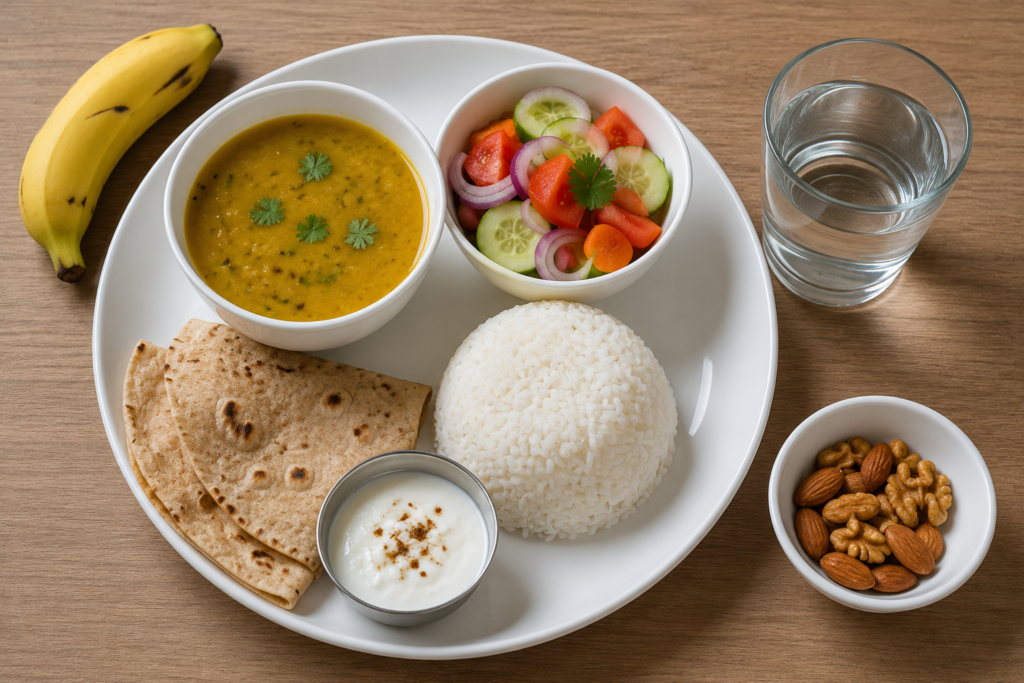
You cannot out-exercise a bad diet. What you eat is just as important as how much you exercise. The good news is that Indian food is already very healthy. You just need to make a few smart choices.
Before your workout eat something light and easy to digest. One banana or two dates with a glass of water is perfect. It gives you quick energy without making you feel heavy.
After your workout eat within 45 minutes. Your muscles need protein and carbohydrates to repair and grow. A bowl of curd with rice or two boiled eggs with a roti is an ideal post workout meal.
Throughout the day focus on getting enough protein. Dal, rajma, chana, sprouts, paneer, eggs, and curd are all excellent protein sources that are part of everyday Indian cooking. Try to include at least two of these in every main meal.
Drink at least 2.5 to 3 litres of water every day. Dehydration kills your energy levels and slows down your progress. Start your morning with a glass of warm water or jeera water to kickstart your metabolism.
Stop or reduce cold drinks, packaged biscuits, and deep fried snacks. You do not need to be perfect but try to replace one bad snack per day with something better like roasted makhana, a fruit, or a handful of nuts.
Do not skip breakfast. Poha, upma, moong dal cheela, or oats with milk are all excellent Indian breakfast options that fuel your morning workout perfectly.
Common Mistakes Beginners Make
Doing too much too soon. Many beginners go all out in week one and end up so sore they cannot move in week two. Start slow. Build up gradually. Your body needs time to adjust.
Skipping rest days. Rest is when your muscles actually grow and repair. Working out seven days a week as a beginner will make you tired and increase your risk of injury. Stick to three or four days per week.
Ignoring form. Doing 20 sloppy squats is worse than doing 8 perfect ones. Always focus on doing exercises correctly before trying to do more reps or add difficulty.
Expecting fast results. You will start feeling better in one to two weeks. Visible physical changes take four to eight weeks. Be patient. Trust the process.
Comparing yourself to others. Everyone starts somewhere. Focus only on being better than you were last week.
How to Stay Consistent
This is the hardest part of fitness for most people. Here is what actually works.
Never miss two days in a row. One missed day is fine and completely normal. But if you miss two days in a row it quickly becomes a habit. No matter how tired you are, do at least five minutes after a rest day.
Find someone to be accountable to. Tell a friend or family member about your fitness goal. Ask them to check in with you. When someone else knows your goal you are far more likely to follow through.
Celebrate small wins. Did you complete your first full week? Tell someone. Did you do your first real push up? Celebrate it. Small celebrations keep you motivated and reinforce the habit.
Track every session. A simple tick on a calendar works perfectly. Over time you build a visual record of your consistency and you will not want to break the streak.
The Role of Yoga and Stretching
India has given the world yoga and it remains one of the most complete fitness systems ever created. Adding just ten to fifteen minutes of yoga to your routine will speed up your progress dramatically.
Surya Namaskar or Sun Salutation is a series of 12 poses done in sequence. Five rounds every morning works every muscle in your body, improves flexibility, and burns around 100 calories. It is a complete workout on its own.
Child’s pose is the perfect post workout recovery stretch. It gently releases tension in your lower back, hips, and shoulders.
Cat cow stretch mobilises your entire spine. Do this every morning to undo the damage of sitting at a desk all day.
Legs up the wall pose done for five minutes before sleep reduces muscle soreness, improves circulation, and helps you sleep much better.
Fitness Tips at Home (India) – Complete Guide for Daily Fitness
Final Words
The hardest part of any fitness journey is simply starting. Not the squats, not the diet, not the consistency. Just that very first moment when you decide to begin.
You do not need to be fit to start. You just need to start to get fit.
Pick one exercise from this guide. Do it today. Just one. Ten squats in your bedroom. One set of wall push ups. A five minute walk after dinner. That is enough for day one.
Come back tomorrow and do a little more. And the day after that. And the week after that.
Fitness is not a destination. It is a daily practice. And every single day you show up, you win.
Start today. Your future self will thank you for it.



Pingback: Vegetarian Diet and Home Workout Plan
Pingback: Fitness Tips at Home (India) – Complete Guide for Daily Fitness
Pingback: How to Gain Muscle for Females at Home Complete Indian Guide